Showing posts with label Climate Change. Show all posts

Saturday, December 10, 2011

Durban: Day 13: Time Running Out


I’ve actually left Durban, and the negotiations are continuing with meetings at the Ministerial level, and an open session stocktaking beginning now (webcast).  A new LCA text was released late morning, and the Parties are expected to convene later this afternoon or evening.  (LCA is the Ad-Hoc Working Group on Long-Term Collaborative Action, the negotiating track that includes all Parties). 
Also, the Kyoto Protocol text hasn’t changed since last night – apparently it’s held until the LCA track is discussed, and conditions seem to be introduced that condition further ambition on developments in the LCA.   

The basic elements of a deal are coming closer together, which include:
- A second commitment period of the Kyoto Protocol, to run from 2013-2017; this will be a two step-process with rules adopted now and pledges proposed in May 2012 and finalized in Doha, Quatar next December. 
- A "mandate" to negotiate a new "legally binding instrument,” to be completed by 2015. 

- Decisions to start the Green Climate Fund, the technology mechanism, the adaptation mechanism, and portions of the financial incentives to reduce emissions from deforestation (REDD), however actual funding pledges are unclear. 
Some impressions from this version:

Legal Form and Mandate – This text is silent on the mandate and timeline for further negotiation, which are being held in the Indaba process.  Indaba is a Zulu word, meaning a sort of “meeting of the elders,” and it’s been the forum for group consultations at the Ministerial level.  The divergent politics on which countries can agree to a mandate or road map that is or isn’t legally binding has the potential to stall the structural and programmatic progress that appears to have been made in the other areas.  Energy & Environment is reporting that the United States, India, and China are objecting to the stated goal of a binding agreement, but for different reasons.  According to the article, the U.S. has direction from the Congress that a legally binding treaty is off the table without “legal symmetry” from all parties.  On the other hand, India and China are inclined to defer the date that they could become bound by an agreement.  At least one article suggests that the deal is off for now, with the time running out, delegates leaving, and the facilities taking the coffee machines away.  The articles below, from Energy & Environment (E&E), reveals some of the politics. 

Shared vision – General statement, agrees to continue work toward peaking and reducing emissions. 

Mitigation – Reiterates 2 degree goal, and the need to consider in the first review strengthening to 1.5 degrees.  Includes reporting process that will include disclosure of assumptions by base year, global warming potential (conversion of value for potent gases), coverage of sectors, land use/forestry, carbon credits from market mechanisms, and conditions associated with pledges.  This could be a more robust annex compared to Copenhagen Accord/Cancun Agreements, because there will be more clarity when expressing reduction commitments. 

Monitoring, Reporting, and Verification – Includes a International Assessment and Review, detailing the content of reports, and the investigation process, but leaves open the compliance process. 

REDD/Deforestation Finance – Directs a process to consider finance for preventing emissions from deforestation, but no major substantive action inserted. 

Market Mechanism – “Defines” a market mechanism, rather than “establishes” one here, before more procedures have been discussed.  The mechanism as defined by the text operates under the guidance and authority of the COP, and also conditions the use of markets toward developed country targets or commitments, though this is to be elaborated.  A separate paragraph emphasizes that credits “must” deliver “real, permanent, additional and verified mitigation outcomes,” “avoid double counting of effort,” and “achieve a net decrease and/or avoidance of greenhouse gas emissions.”

Response Measures – Includes language on a just transition of the workforce and quality jobs.  Urges developed countries to assist in economic diversification in the context of sustainable development. 

Adaptation – Further structures the Adaptation Committee, including representation from a “small island developing state,” and a “least developed country.”  The Committee is requested to continue workshops and reports over the next year. 

Finance – Directs a work program for the Green Climate Fund Steering Committee to conduct, focused on developing a registry of projects and improved financial management for fast-start finance, options to mobilize resources for long-term finance, which include public and private, bilateral, and multilateral. 

Technology – Directs the Climate Technology Centre and Network to conduct research, development, and demonstration of new climate-friendly technologies, and begins a selection process to select the host country.  Funding to come from the financial mechanism, philanthropy, and the host country. 

Capacity-building – Establishes an annual “Durban Forum” for a review of efforts, and links back to the financial mechanism. 

Review – Confirms the first review starts in 2013, and should complete by 2015, to take into account the best available scientific information, and an assessment of actions taken by Parties, based on the forthcoming IPCC report and other sources. 

______________________________________________________
Durban talks -- 'a pressure cooker' -- go down to the wire
Lisa Friedman, E&E reporter
Friday, December 9, 2011


DURBAN, South Africa -- Nervous energy filled the halls here as midnight loomed on the final night of U.N. climate talks, where activists and diplomats alike awaited the release of new text outlining how countries intend to curb greenhouse gas emissions.

At issue here in the tense final hours of the negotiations are both the future of the 1997 Kyoto Protocol and what countries might be willing to do after 2020 to rein in emissions.

An "indaba" -- a Zulu word that loosely translates to a meeting of elders that the South African conference presidency has been using to describe smaller high-level meetings -- broke up around 9 p.m. local time after impassioned pleas for survival from vulnerable countries directed at the United States, as well as the so-called BASIC countries of Brazil, South Africa, India and China.

"We're here waiting for text and for some people to calm down," said David Waskow, climate policy director at Oxfam America. "It was a pressure cooker, from everything we've heard."

Small island nations and least developed countries are pushing for a mandate from Durban to develop a legally binding treaty that forces all major emitters -- including the United States and China -- to reduce emissions and to enact tougher emission reduction targets before 2020.

For different reasons, both the United States and the major emerging economies have put up roadblocks to deciding here in Durban that they plan to work toward a legally binding agreement.

The United States does not want to do anything until it can be sure that China and other major emitters are bound by the same legal rules as developed nations.

China and India, however, have their own set of conditions before they are legally bound to cut carbon -- including ensuring that they remain part of a protected category in which efforts to cut emissions are strictly voluntary.

A document that the United States, China and some others offered as a consensus option this afternoon -- calling for a new "legal framework" -- was rejected by small island nations and called toothless.

"We hear expressions of concern, yet some countries say they will not do anything until 2020. We see that as irresponsible," said Ian Fry, Tuvalu's lead negotiator. "For us this is a security issue, and we would need to consider this in the context of the [U.N.] Security Council."

Jennifer Haverkamp, who leads the Environmental Defense Fund's international policy team, said that in order for a package to work, countries need to agree to put something in force by or before 2020 and find a way to boost the current pledges for cutting emissions -- pledges that several studies have said are not sufficient to avert the worst impacts of global warming.

"In this negotiation right now, the U.S. has the opportunity -- if it can show more flexibility and ambition on the legal binding agreement -- at the end of the road, they hold in their hands the opportunity to make this a good outcome," Haverkamp said.


U.S. will be responsible if climate talks break down, top E.U. negotiator asserts

Jean Chemnick, E&E reporter

Published: Friday, December 9, 2011


DURBAN, South Africa -- If the U.N. Climate Conference ends today without an agreement -- throwing doubt on the future of climate negotiations -- the U.S. will be largely to blame, Europe's top climate change negotiator charged today.

"If there is no further movement from what I have seen until 4 o'clock this morning, then I must say I don't think there will be a deal in Durban," the European Union's commissioner for climate action Connie Hedegaard told reporters Friday morning, hours away from the end of the 17th Conference of the Parties.

"I think it's clear that the responsibility lies very, very heavily on the shoulders now of those few big ones who are still not giving in so much as for us to be able to agree what we need to agree," she continued.

The E.U. has spent the COP lobbying other countries to sign on to its so-called roadmap for action on emissions reduction, which would bind the E.U. and some other countries to a second commitment period under the Kyoto Protocol, while others, including the U.S. -- which is not covered by the protocol -- agree to negotiate a new, broader legally binding agreement for after 2020.

Europe has had some success. Yesterday a group of developing nations and small islands signed a joint statement with the E.U. declaring that they would be bound by the broader agreement.

"The price of buying time is rising. Durban must deliver," they concluded. "We urge others to join."

But others have not joined. China, India and the U.S. have remained in their entrenched positions.

Frustration builds during final hours

Hedegaard -- cutting the air with her arms as she spoke -- expressed frustration that major emitters had not softened their opposition to the roadmap despite numerous discussions over the past two weeks. The press has reported some movement from both China and the U.S. in the past week, but both have turned out to be misunderstandings.

The U.S. continues to demand that major developing emitters such as China and India agree to be bound by emissions targets before negotiations begin. Hedegaard noted that small developing nations, Brazil and South Africa have all said they will be bound by the broader treaty.

"We all know what the challenge in the United states is, but we also know that for many years it has been an American ask that we should all be equally legally bound," she said.

But Andrew Light, director of the international climate program for the Washington-based Center for American Progress, said that the E.U. delegation is actually divided on how much they need to see at Durban before the union can sign on to a second commitment period under the Kyoto Protocol.

He said that senior E.U. negotiator Artur Runge-Metzger has said in negotiations that beginning a discussion might be enough -- the U.S. and other countries may not need to spell out that they will accept binding targets after 2020 at the outset, he said.

'A lot of blame to go around'

"Connie seems to me to be pushing the strongest possible interpretation of the outcome they are looking for -- that whatever they can agree to on the roadmap, it must become legally binding," he said. "I couldn't say whether there is disagreement on the goal post among the E.U. negotiators but Artur's analogy for what they want makes this all seem more palatable."

He added that assigning the U.S. blame in advance if the process fails to yield an agreement tonight is unproductive. It is equally true to say that the E.U. caused that failure, because it, too, entered the talks with preconditions.

"It would be causally true that the meeting might fail because the E.U. refuses to extend the [Kyoto Protocol] because China, India and other parties refused to agree to the mandate they have asked by way of a 2020 mandate," he said.

"If the meeting fails -- which would mean that parties withhold their consent on all the other non-KP parts of the deal because the KP does not continue -- then the trigger won't be pulled by the U.S. or the E.U. but by developing countries who insist that the KP must continue," he said. " So, if the meeting fails then there will be a lot of blame to go around. "

The African delegation has made the preservation of the Kyoto Protocol the top priority for this COP, but its top negotiator took a somewhat more forgiving tone toward the big holdouts then Hedegaard did.

Tosi Mpanu-Mpanu, the outgoing chairman of the African group of negotiators, said that countries who are able to make commitments should do so now, leaving open the door for others to follow in the future.

"We should encourage people to do what they can do," he said.

"I think we can come up with a comprehensive instrument that will take on board most of us," he said.

He called on the E.U. to "show virtuous leadership as they have in the past" and sign on to a second commitment period under Kyoto no matter what other major emitters do. But Hedegaard all but ruled that out during her press conference.

"If we are discussing options where people are telling us to ratify and rather today than tomorrow, but then in return we would get is that we start some kind of process to end no later then 2020, then I think everyone could see, that is not exactly a good deal," she said.

"It's not a balanced deal, but it is also a really, really poor deal from a climate perspective," she added.

Friday, December 09, 2011

Durban Day 12: As the Clock Ticks, Will There Be Progress? 
Thursday night, options for a big picture plan forward emerged, with a summary posted on the UNFCCC website, accompanied by a chart of the options and the outcome for the Kyoto Protocol second commitment period.  Reuters reported earlier that support is growing for an EU plan to have a “road map” toward a new “climate change regime” by 2015, but the latest news is that this is being resisted by developing countries, favoring language such as a “binding instrument.”

This seems to be consistent with Options 2a, 2b, and 2c from the Ministerial talks last night.   Also released at 4pm today was an 8am time-stamped document with text on the legal form of the roadmap.  The draft text, among other nuances:

- Recognizes the need to hold the increase in global average temperature below 2 degrees, and includes language to consider strengthening the goal to 1.5 degrees. 
- Notes the Kyoto Protocol and Cancun Agreements, and Decides to complete the outcome called for by the Bali Action Plan.
- Decides to launch a process to develop a legal framework that would apply to all under the UNFCCC through a new negotiating track.
- Sets a timeline ending no later than 2015 to complete the work.
- Decides that the process shall encourage increased ambition, and refers to a 2013-2015 review. 
- A paragraph recognizing the challenge of implementation implies that the outcome might come into force after 2020. 

The negotiations closed late tonight after the agenda was approved, to reconvene tomorrow morning.  Looks like they’ll be going into overtime. 

Update: The President released new draft text on negotiating timeline and road map/mandate, Green Climate Fund, and Kyoto Protocol. 

The new road map text expands the mandate to either a new "protocol or another legal instrument."  It also drops the language about "after 2020," and is silent on when an outcome would come into force. 

Meetings may reconvene after 10am on Saturday. 

Thursday, December 08, 2011

Youth Videos

The United States Youth put together a video with the message that it's too late to wait -


For the third year, since Copenhagen, youth organizations from the United States and China have also collaborated on a dialogue about our climate future.  The debrief is here:

Durban Day 11:

I’ve posted mostly on mitigation, including market mechanisms, and legal form.

Some notes and links to resources and information from news and different perspectives on some other issues that are important to the negotiations:

2nd Commitment Period of the Kyoto Protocol –

Green Climate Fund –
International Business Times – Ban Ki-mood Demands Action on GreenClimate Fund

Monitoring, Reporting, and Verification (MRV) – Insights from the World Resources Institute

Forestry –


Adaptation –


Technology Transfer – China Daily - Technology mechanism discussionhopeful to be completed

Capacity Building – UN Documents

Wednesday, December 07, 2011

Durban Day 10: Picking Up the Pace
My blog post from today also ran in Sierra Club’s Compass blog: http://sierraclub.typepad.com/compass/2011/12/cop-17-united-states-climate.html

The UN climate negotiations are winding up, with foreign ministers arriving.  The negotiating tracks on the wide range of issues from mitigation, finance and the green climate fund, adaptation, and other issues are producing language that could result in an outcome in Durban that helps facilitate international collaboration on combating climate change, but the progress so far is slow and incomplete compared to the needed reductions to avert the catastrophic impacts of global climate change. 
At the center of the debate is the commitments to reduce emissions, and how the Parties interpret the UN Framework Convention’slanguage of “common but differentiated responsibilities,” a principle that recognizes that developed countries such as the United States should bear a greater reduction responsibility than developing countries.  Meanwhile, the United States bargaining position calls for “legal symmetry,” or an equivalent legal form of commitments, for agreement. 
Sierra Club’s efforts to advocate for standards on clean cars and fuel, greenhouse gas standards from power plants, and other measures under EPA authority are likely enough to achieve the 14-17% if the Obama Administration can implement them, but we have to push beyond that, moving beyond coal and toward renewable energy.  The science indicatesthat current pledges under the Cancun Agreements amount to global emissions of 55 billion tons of CO2 in 2020, which is 11 billion tons above meeting the 2 degree target.  This level of emissions leaves us headed toward a temperature rise of 3.5 degrees Celsius (6.3 degrees F) which will lead to extreme storms and heat events, damaged water and agricultural systems, sea level rise, and air quality and public health impacts. 
U.S. Special Envoy for Climate Change Todd Stern arrived for the second week of the climate talks, and briefed the environmental community Tuesday evening, acknowledging that there are no plans to expand the ambition of the current U.S. target of 14-17% reduction below 2005 levels by 2020, but expressing optimism that the outcome will include agreements on adaptation, technology transfer, and launch of the green climate fund.  Although Sierra Club members and advocates from other organizations have repeatedly questioned the U.S. delegation on how the U.S. will work toward negotiating a pathway toward limiting climate change to 2 degrees Celsius, the commitments from the Administration seem held in place under the current Congress.  While we need the U.S. and international community will come to an agreement in Durban on a pathway to stabilize the climate, we also need to double-down on our climate protection campaigns at home in the U.S.

Tuesday, December 06, 2011

Durban Day 9: The Planet Warming, Pressure Building

Hand Puppet Hilarity: After a week of stalled negotiations, some humor is in order.  This video using hand puppets does a pretty good job of capturing in a nutshell the state of play right now:

Environmental Organization CEO’s Letter to Secretary Clinton
Leaders of 16 environmental groups sent a letter to Secretary of State Hillary Rodham Clinton with some tough words on the administration’s negotiating stance on the international climate talks now taking place in Durban, South Africa. “America risks being viewed not as a global leader on climate change, but as a major obstacle to progress,” they wrote. “U.S. positions on two major issues – the mandate for future negotiations and climate finance – threaten to impede in Durban the global cooperation so desperately needed to address the threat of climate change.”
Washington Post Story
Senators Write to Clinton

Kerry, Colleagues on Durban International Climate Conference
WASHINGTON, D.C. – Senator John Kerry (D-Mass.), Chairman of the Foreign Relations Committee and long-time advocate for energy independence, today called for an “ambitious outcome” from the international climate negotiations currently convened in Durban, South Africa.
“With the impacts of climate change occurring more quickly than previously predicted, we are committed to doing our part to transition to a clean energy economy that decreases carbon pollution, creates jobs, and builds resilience in vulnerable communities both at home and abroad,” Kerry and 14 of his colleagues wrote in a letter to Secretary of State Hillary Clinton.
“COP 17 is an important opportunity for the global community to continue to make progress in implementing the Cancun Agreements reached last year in Mexico. There, for the first time, all major greenhouse gas emitting nations, agreed to anchor their commitments to reduce carbon pollution in an international agreement. Building on this, we look forward to an outcome in Durban that provides guidelines for how these actions are measured, reported and verified,” the members added.
During his time in the Senate, Kerry has traveled to seven international climate negotiations, including the first summit in Rio de Janeiro in 1992, followed by conferences in Kyoto, Buenos Aires, the Hague, Bali, Poznan, and most recently Copenhagen in 2009.

The full text of the letter is below:
December 5, 2011

The Honorable Hillary Rodham Clinton

Secretary of State
U.S. Department of State
2201 C Street NW
Washington, DC 20520

Dear Madame Secretary:

We are writing to show our strong support for an ambitious outcome from the United Nations Framework Convention on Climate Change (UNFCCC) summit in Durban, South Africa.

As host to this year’s 17th Conference of the Parties to the UNFCCC (COP 17), South Africa plays an important role, not only as a principal forum for discussions on climate change, but also because it represents a region extremely vulnerable to the effects of climate change. Globally, climate change is projected to increase the frequency and severity of extreme weather events like droughts. The consequences of these projected impacts can be seen in especially stark terms today in the Horn of Africa, where a major drought has left nearly thirteen million people in need of humanitarian assistance.

A changing climate will affect all aspects of our lives. The many weather-related disasters that occurred in 2011 also underscore the seriousness of climate science projections of increasingly severe floods, droughts, and other disasters. We are vulnerable in the United States, where a record fourteen disasters with greater than $1 billion in damages have occurred this year. But communities living in poverty that have done the least to cause the problem, like many in Africa, are particularly vulnerable and are least able to adapt to these changes without external assistance.

With the impacts of climate change occurring more quickly than previously predicted, we are committed to doing our part to transition to a clean energy economy that decreases carbon pollution, creates jobs, and builds resilience in vulnerable communities both at home and abroad.

In addition to taking action in the United States, we support a strong, coordinated international effort to advance these goals. COP 17 is an important opportunity for the global community to continue to make progress in implementing the Cancun Agreements reached last year in Mexico. There, for the first time, all major greenhouse gas emitting nations, agreed to anchor their commitments to reduce carbon pollution in an international agreement. Building on this, we look forward to an outcome in Durban that provides guidelines for how these actions are measured, reported and verified.

We also encourage the Administration to support innovative approaches to generate additional public and private sources of climate financing. To this end, we support an outcome in Durban that makes progress on contributions from other sources, including international transportation sectors and market mechanisms, and a process for determining how these sectors contribute to the long-term financing target. We also support establishing guidelines for the operation of the Green Climate Fund designed to maximize impact, effectiveness, and efficiency. The Fund should be transparent and accountable and ensure the meaningful participation of affected communities and civil society, while contributing to sustainable, vibrant local economies in developing countries through projects with environmental and social safeguards.

Finally, we look forward to an outcome that includes further discussions on the actions to ensure global temperatures do not rise beyond the two degrees Celsius target, with a review of its adequacy; progress on increasing the resilience of vulnerable developing countries; and strengthened efforts to increase forest conservation and reduce emissions from deforestation. We look forward to working with you to advance a strong and ambitious package of outcomes from Durban to address the global climate crisis. As the costs and effects of climate change continue to mount, it is critical that the U.S. be an active part of an effective global response.
Sincerely,

John Kerry                              Patrick Leahy                          Jeff Bingaman
United States Senator             United States Senator             United States Senator

Joe Lieberman                         Barbara Boxer                         Dick Durbin
United States Senator             United States Senator             United States Senator

Jack Reed                                Tom Carper                             Frank Lautenberg
United States Senator             United States Senator             United States Senator

Bernard Sanders                     Sheldon Whitehouse               Tom Udall
United States Senator             United States Senator             United States Senator

Chris Coons                            Ben Cardin                              Richard Blumenthal
United States Senator             United States Senator             United States Senator
Jeanne Shaheen
United States Senator

Monday, December 05, 2011

Durban Day 8: To the (Real, Verified, Additional, Permanent) Market
In one of the areas that I’m tracking, called “various approaches, including the use of markets,” the document considers the establishment of a market mechanism to enhance greenhouse gas mitigation activities.  The consensus-building process often starts at the lowest common denominator – the UNFCCC does not have an approved voting procedure, which means there must be consensus to proceed, although this doesn’t mean unanimity. 

Parties raised concerns from all angles – Papua New Guinea, on behalf of the Group of 77 and China, mostly developing countries), expressing frustration that the text didn’t unequivocally establish a market mechanism this year.  Japan and India were concerned that establishing common standards on integrity at the UN level could restrict their access to credits and projects, Australia calling for environmental integrity in the system, but supportive of carbon markets overall, and Grenada insisting on safeguards for integrity, and that any trading be supplemental to domestic reductions.  The U.S., while supporting the principle of credits being real, additional, permanent, and verifiable, prefers a work program to study these principles, so the Parties can consider establishing a framework next year. 

In my discussions with environmental organizations, the U.S. negotiator for this issue, and officials at the California Air Resources Board, it’s apparent that California will have an important role to play in implementing a carbon market in a way that achieves a real decrease in emissions.  With California as the first American carbon market aiming to link internationally, an important facet of California’s program is that most of the reductions, nearly 80 percent, come from direct regulations that clean up our cars, fuels, and energy generation, with cap-and-trade more as a “backstop.”  Neither the climate nor the sustainability of an emissions trading system wins if there are credits that amount to double-counting, or that can’t be verified as a net decrease in emissions.  However, a key challenge to is determining whether there is a “net decrease” without quantification of an emissions inventory where the clean development projects are taking place. 

Friday, December 02, 2011

Durban Day 6:

The amalgamation of draft text was released in the Long-Term Collaborative Action (LCA) track, setting up much discussion and reading over the next few days. 

Saturday was also the Global Day of Action, with a 12,000 person march through the city of Durban for climate action.


More pictures here. 

Durban Day 5

Forward movement? On Friday of the first week, a China Daily news article raised some hope that mitigation commitments could be coming together.  While China’s statement that they are contemplating an absolute emission limit, rather than a relative limit per unit of economic activity, helps to raise the ante, it wasn’t received as a certain development, as the target is conditional on economic development through 2020.  Still, the provision in the newest 5-year plan to set a limit on coal production is a small step forward, although China consumes about 46 percent of the world’s coal. 

Other topics under discussion today –

Keeping the Clean Development Mechanism Clean - Developing a grievance or appeals process for the Clean Development Mechanism – the emissions trading system in place for Parties to the Kyoto Protocol.  Advocates have been concerned about approved projects that are not in fact additional to what would have otherwise occurred but for the credit received.  The CDM approved a few coal energy projects before establishing a moratorium on credit for coal power plant.  Advocates are pushing for this temporary moratorium to become established policy so that the trading system has environmental integrity. 

Clearing Up The Hot Air – A flexible compliance mechanism is only as good as the rules that ensure the right balance between flexibility and integrity of the system.  Advocates looking closely at the CDM have spot a series of loopholes negotiated in the process.  They’re looking critically at
-        Carry-over of overallocated AAUs (carbon credits) during the first commitment period.
-        Problems with forestry accounting rules.
-        Emission reduction projects that would have been built anyway (non-additional).
-        Double counting emission reductions by attributing them to both developed and developing countries
-        Emissions from aviation and shipping (“bunkers”), which are not accounted for in the Kyoto Protocol. 

Page 6 of the UN Environmental Program Report on closingthe Emissions Gap suggests that the difference between lenient and strict rules can amount to 2 – 3 Gigatons of CO2e, or nearly 20 – 30 percent of the gap of emission reductions needed. 

Links – Check out TckTckTck’s Hub on COP 17


Thursday, December 01, 2011

Durban Day 4: Legal Form: They Also Have to Agree on How to Agree

One of the most controvertial issues is the legal form of the outcome from the climate talks.  While the popular understanding, and legal form with the greatest expectations of certainty and compliance, is a legally-binding treaty, several countries from different negotiating blocs have initially rejected this approach, broadening the discussion to a range of alternatives. 

Today, I tracked the meeting where countries discussed a "menu" of legal options, first outlined in the Cancun Agreements, paragraph 145, and had drafted an intervention (like a public comment by an observer organization) that was presented by the Climate Action Network.  Several countries weighed in on the options, which include:

1. Legally Binding Instrument(s)
2. COP (Conference of the Parties) Decisions
- Continue discussions to identify the appropriate form of the different elements of the agreed outcome.
- Mandate to conclude a legally binding instrument with a clear roadmap/main content.
- Affirm the importance of a legally binding outcome to provide clarity and vision.
- Statement/declaration regarding future instrument(s) leaving open the legal form.
- Continue substantively addressing all pillars of the Bali Action Plan through COP Decisions. 

There's a saying that "if you're not confused, you're not paying attention." The 192 countries here are parties and observer states to the United Nations Framework Convention on Climate Change (UNFCCC). This framework convention sets common definitions and is a forum for the Parties to discuss approaches to addressing climate change. Under the convention, there's the Kyoto Protocol, in which 37 developed (Annex 1) countries have committed to a reduction in greenhouse gas emissions by 5.2 percent below 1990 levels by the year 2012. This legally binding commitment ends next year, raising questions about what comes next.

At stake is the future of the instrument that is an actual legally binding treaty, but only covers 20 percent of global emissions. The Kyoto Protocol does not include commitments that apply to developing countries that are also considered emerging markets, such as China and India. In Copenhagen, countries agreed to a political agreement to pledge their emission reductions, and many "Annex II" countries that are not legally bound to commitments under the Kyoto Protocol agreed to reductions in the Copenhagen Accord, a political agreement that was not adopted by the UNFCCC, but was next detailed and adopted into the Cancun Agreements.

This system is a "pledge and review" approach, which has the advantage of including countries that the United States has wanted to see included in an agreement, but has the disadvantage of pledges that fall far short of what scientists say is necessary. Also at issue is the principle of "common but differentiated responsibilities," a cornerstone principle of equity between developed and developing countries, but left with "constructive ambiguity," left open to interpretation and further disagreement about what this actually means. The Climate Action Network, the coalition of environmental organizations from around the world, is calling for a legally binding treaty by 2018, to coincide with the end of a second commitment period of the Kyoto Protocol. 

The talks are continuing, with some Parties calling attention to the importance of certainty and trust from a legally binding treaty, and some Parties doubting the political feasibility of entering into binding commitments with ambitious targets, preferring first to achieve political commitments, and perhaps later codify into a treaty.  While function follows form, here it may also be that the form is following function. 

Wednesday, November 30, 2011

Durban Day 3: An Extreme Warning, Negotiations Pick Up

The negotiations plenary opened with a statement from Rajendra Kumar Pachauri, the Chairman of the Intergovernmental Panel on Climate Change (IPCC).  The IPCC publishes authoritative and comprehensive scientific reports to advise global decision-makers on climate science. 
Global warming isn't just about the average temperature rising by several degrees.  It's the extreme events that are particularly concerning.  Some notable quotes:


It is very likely that the length, frequency and/or intensity of warm spells, or heat waves, will increase over most land areas. Based on specific emissions scenarios, a 1-in-20 year hottest day is likely to become a 1-in-2 year event by the end of the 21st century in most regions, except in the high latitudes of the Northern Hemisphere, where it is likely to become a 1-in-5 year event.  The 1-in-20 year extreme daily maximum temperature (i.e., a value that was exceeded on average only once during the period 1981–2000) will likely increase by about 1°C to 3°C by mid-21st century and by about 2°C to 5°C by late-21st century, depending on the region and emissions scenario.
When I had the privilege of accepting the Nobel Peace Prize on behalf of the IPCC I asked the rhetorical question, “Will those responsible for decisions in the field of climate change at the global level listen to the voice of science and knowledge, which is now loud and clear?
The United Nations Environment Programme released a report titled "The Emissions Gap," examining a range of emission reduction scenarios, including the scenario called for in the Copenhagen Accord and Cancun Agreements.  The report concluded that there is a significant gap between scientific reality and the current level of ambition of nations. 

Tuesday, November 29, 2011

Durban: Day 2

53 Members of Congress Call on Obama Administration to Pursue Ambitious Agenda in Durban

Although this is last week's news, it's important that 53 members of Congress, including Oakland Representative Barbara Lee, wrote a letter to Secretaries Clinton and Geithner urging the Administration to pursue an ambitious agenda at the Durban Climate Change Summit.  The letter focuses on the extreme weather events expected to intensify as a result of global warming, and calls for operationalizing the Green Climate Fund and reiterating the commitment made in Copenhagen to reduce greenhouse gas pollution. 

Maite Nkoana-Mashabane of South Africa, UNFCCC President
UNFCCC President Calls for Optimism

Maite Nkoana-Mashabane, President of the UNFCCC for COP 17, quoted Nelson Mandela, who said "It always seems impossible until it's done."  This year's conference is anticipated to have a more uncertain outcome than ever before, with much at stake. 
The first commitment period of the Kyoto Protocol is set to expire, with wide disagreement over what a second commitment period should look like.  Japan and Canada are indicating that they cannot agree to further commitments unless major developing countries and the United States also commit to reductions.  The United States is focused on implementation of the Green Climate Fund and other aspects of the Copenhagen Accord and Cancun Agreements, but is currently deferring negotiation of more ambitious targets until years in the future, in great part because of domestic dirty energy politics.  Reciprocally, India says they won't agree to further reductions unless the U.S. does the same.  India and China are calling for a second commitment period for the Kyoto Protocol.  Europe will only continue for a second Kyoto commitment period if they are not the only countries carrying the load, particularly if the United States accepts reductions.  Many African and small island states, with a low per-capita carbon footprint, are focused on survival, in anticipation of the devastating impacts of extreme heat and sea level rise on their countries. 

Key issues include mitigation commitments, the legal form of any mandate (forms of either political agreement or binding treaty), the structure, priorities, and commitments of a new Green Climate Fund to assist developing countries achieve clean development, reducing deforestation, technology transfer and capacity building, the role and integrity of carbon markets to facilitate these goals, and adaptation. 
Two common themes in the negotiations are (1) the ambition of commitments, but also (2) responsibility for acting to address climate change.  The countries of the world are still far apart, but for the last two years have agreed on the crucial goal: to limit global warming to no more than 2 degrees Celsius. 

A highlight of my day was a briefing for United States Youth with Deputy Special Envoy for Climate Change Jonathan Pershing.  Although the briefing was an important opportunity to better understand and ask questions about the U.S. position on the issues, the situation is complex, and the answers were often not what we wanted to hear.  I'm consistently inspired by the other young people who are actively engaging in the process, through both the long periods of slow progress, and the moments of breakthrough. 

In tracking the negotiations, I'll be focusing on issues related to legal form and flexible / market mechanisms, cross-posting other news and views from the conference, and later this week I'll share South African sustainability exhibits on display outside the conference center. 

Monday, November 28, 2011

Durban - Day 1 - Will the World Act in Time?

The 17th Conference of the Parties (COP 17) began today in Durban, South Africa, where once again 192 countries are gathered for the next two weeks to consider how to reduce greenhouse gas emissions and avert the most serious impacts of climate change.    The progress thus far has been too slow, and often with steps in the wrong direction. The International Energy Agency recently reaffirmed that without more ambitious commitments to limit emissions of heat-trapping gases over the next decade, that we are extremely unlikely to meet the goal set by President Obama and other leaders in Copenhagen of keeping global temperatures from increasing more than 2 degrees Celsius above pre-industrial levels.  

Canada announced today an intention to leave the Kyoto Protocol, the binding agreement that requires member developed countries to reduce agreed-upon emissions. There are also serious questions as to whether the negotiations will have a meaningful discussion toward a binding agreement to protect the climate, or the launch of the Green Climate Fund agreed to last year in Cancun.  

Stay tuned for daily progress updates, in-depth discussion, links to information resources, and pictures.  

Also, this is information about what the Sierra Club delegation is up to in Durban: 

Today kicked off what will be a busy and exciting week for the Sierra Club's COP 17 delegation in Durban as we connect with partners fighting dangerous coal development around the globe, promote renewable energy solutions, work on climate finance and addressing gender issues, and build the international youth movement. Some members of the delegation even got a head start, arriving in Durban early for the Conference of Youthand Dirty Energy Week.

The Sierra Club will be on the front lines over the next two weeks as we:

• Partner with Greenpeace International on the "Coal, the Dirty Truth" side event inside the conference on Tuesday, November 29.
• Join the Carbon War Room and the Mary Robinson Foundation for a special event to discuss on energy access on Thursday, December 1. 
• Participate in the Global Day of Action march in Durban with activists from around the world on Saturday, December 3. 
• Present on the health impacts of deadly coal pollution at the Climate Health Summit with Health Care Without Harm on Sunday, December 4. 
• Host a Move Beyond Coal workshop with groundWork South Africa on Monday, December 5. 
• Discuss environmental and labor alliances as part of the Blue-Green panel at the World of Work Pavilion on Monday, December 5.
• Stage visibility events to highlight the dangers of coal and the need for action, including a funeral for coal and heads in the sands photo op.
• Hold the first ever Sierra Club booth inside the conference to discuss who we are and what we do during the second week.
• And much, much more! Stay tuned to thedelegation blog to get the latest info. 

Friday, December 10, 2010

Cancun Climate Talks Slow, but Steady

For the past week, I’ve been at the UN Climate Negotiations in Cancun, as part of the Sierra Club delegation. Today is the last official day of the conference, so I’m taking the time to reflect on my experiences and discuss how the negotiations were progressing.
Before I left, I already understood a tragic irony of holding the 16th Conference of the Parties of the United Nations Framework Convention on Climate Change here in Cancun. A well-known impact of global climate change is sea level rise, with the Intergovernmental Panel on Climate Change finding a rise in sea level of 1-2 feet within the next 100 years, and recent evidence finding an accelerating rate of glacier melt that could cause sea level rise of over 6 feet. As I looked out east into the Gulf of Mexico from my shuttle bus, I was surrounded by the beauty of the coast and the waves flowing into the sand on the beach, hoping that there would be a commitment among world countries to protect our climate.

Over 600 million people live in coastal areas that are less than 10 meters above sea-level, and two thirds of the world’s cities with populations over five million are located in these at-risk areas. The EPA estimates 26,000 square kilometers of land lost if sea level rises by 2/3 of a meter, and 33% of coastal land and wetland habitats are likely to be under water.

That’s why the Sierra Club staged an event featuring 350.org founder Bill McKibben to pull the world’s heads from the sand. I’m glad to say this image carried in dozens of media outlets at the end of the first week of the conference. 

The Road from Copenhagen

The Copenhagen Accord, while not the binding global climate deal hoped for, achieved several political agreements.  It:

* Set a long-term goal of limiting global temperature increase to no more than 2 degrees C
* Set forth a process for States to report their greenhouse gas reduction targets of both developed and developing countries
* Included financing plans including "fast start" money for 2010-2012 "approaching" 30 billion, and a goal of $100 billion per year by 2020.
* Provided for developed country monitoring, reporting, and verification, and developing countries to monitor emissions and report through national communications, with "international consultation and analysis."

However, the Copenhagen Accord didn't accomplish:

- A long term emissions reduction target.  Early drafts included the 50 percent global reduction by 2050 (including 80 percent from developed countries) agreed to by the G-8. 
- Pledges that add up to a path to the goal of limiting temperature rise to 2 degrees C.  Rather, they may add up to a 3-4 degree rise in temperatures, requiring more ambitious pledges. 
- Mitigation pledges that are legally binding, since the Copenhagen Accord is a political agreement, and the Conference of the Parties (COP) merely "took note of" it and did not "adopt" it as a decision. 

Over the past two weeks, member groups of the Climate Action Network (CAN International) have been urging a fair, ambitious, and binding deal, including (1) stronger developed country emision reductions, (2) clear monitoring, reporting, and verification (MRV) and compliance system for developed country emissions, (3) agreeing to minimize loopholes that may remain in land use and forestry rules, and preventing double-counting in market mechanisms, (4) nationally appropriate mitigation actions for developing countries including MRV, (5) a Climate Fund to finance clean energy efforts, capacity building, technology development, and adaptation for the most vulnerable countries, and (6) clarity on the legal framework and path forward. 

While the talks are progressing and a draft agreement moves many of these issues forward, the ambitious goal of binding targets from developed countries on the order of 25-40% is unlikely until the United States is ready to take action.  The head of the U.S. delegation, Jonathan Pershing, has explained to environmental organizations that ratification by the U.S. Senate, and passage of climate and energy legislation are constraints of what the U.S. can agree to.    

State and Local Actions Critical

Coming from California, it is clear that our Global Warming Solutions Act, which requires a reduction of greenhouse gas emissions to 1990 levels by 2020, is a bright spot of climate action in the United States, and therefore a ray of hope in the world. 

We don't have time to wait for Congress to adopt climate legislation.  At best, renewable energy incentives that started in the stimulus may stay alive for an additional year, but they were nearly removed.  California is developing clean energy and energy efficiency programs that will reduce air pollution, protect public health, and create half a million jobs.  California is developing new standards for cars and fuel that are key to the United States meeting its 17% by 2020 reduction target. 

California voters strongly support climate protection, defeating Proposition 23 by 63% in the November 2010 election, and electing Governor-elect Jerry Brown, running on a clean energy jobs platform to get California working again. 

Obama EPA Taking Action

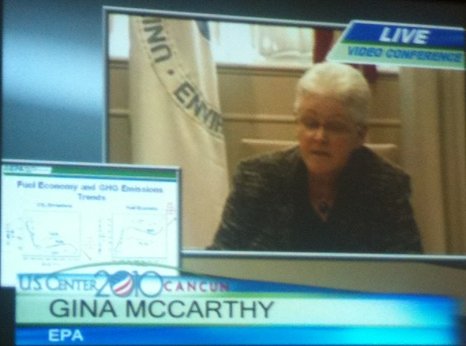
The Obama Administration isn't waiting for Congress either, and has implemented the Clean Air Act to get started on achieving greenhouse gas pollution reductions.  EPA Assistant Administrator Gina McCarthy outlined United States efforts since Copenhagen, including the first greenhouse gas standards for passenger vehicles, the first proposed greenhouse gas standards for medium and heavy-duty trucks, and the first year of collecting greenhouse gas emissions data under the mandatory reporting program. 

The clean cars standards first adopted in California set an average emissions level of 250 grams of CO2 per mile in model year 2016, equivalent to 35.5 mpg, and reduces greenhouse gas emissions by 950 million tons.  A second phase to be proposed in Fall 2011 is evaluating more than 30 technologies to further reduce emissions during 2017-2025 to the equivalent  of 47-62 mpg.  The renewable fuel standard sets a goal of increasing renewable, low-carbon fuel to 36 billion gallons by 2022, reducing 138 million tons of CO2, replacing about 7 percent of expected annual gasoline.  Additionally, new or modified stationary sources and power plants will need to adopt the most efficient technologies available to minimize emissions.  This can help reduce unhealthy emissions from coal-fired power plants throughout the United States, preventing tens of thousands of premature deaths. 

The Obama Administration's EPA actions are promosing, but cannot be taken for granted.  Sierra Club's Bruce Niles wrote earlier this year about the importance of stopping the Murkowski Amendment, which would have eliminated the EPA's authority to regulate greenhouse gases, and rejected the science supporting the EPA's endangerment finding that greenhouse gases endanger our health.  Defending the EPA must remain a priority in addition to pushing for stronger action at the state and federal levels. 

National Security Risks of Climate Change
USMC Brigadeer General Ayaha

The Department of Defense presented at the U.S. Center at the Conference on DOD's analysis of risks expeced due to Climate Change. R. Admiral David Titley noted that many coastal military installations will be vulnerable from sea level rise, melting ice in cold areas such as Alaska, and hotter weather in the southwest. Lt. Colonel Paul Schimpf and Marines Brigadeer General Juan Ayala also commented on the impacts of climate change and how destabilizing societies posing long-term security risks due to food and water shortages and mass migration.